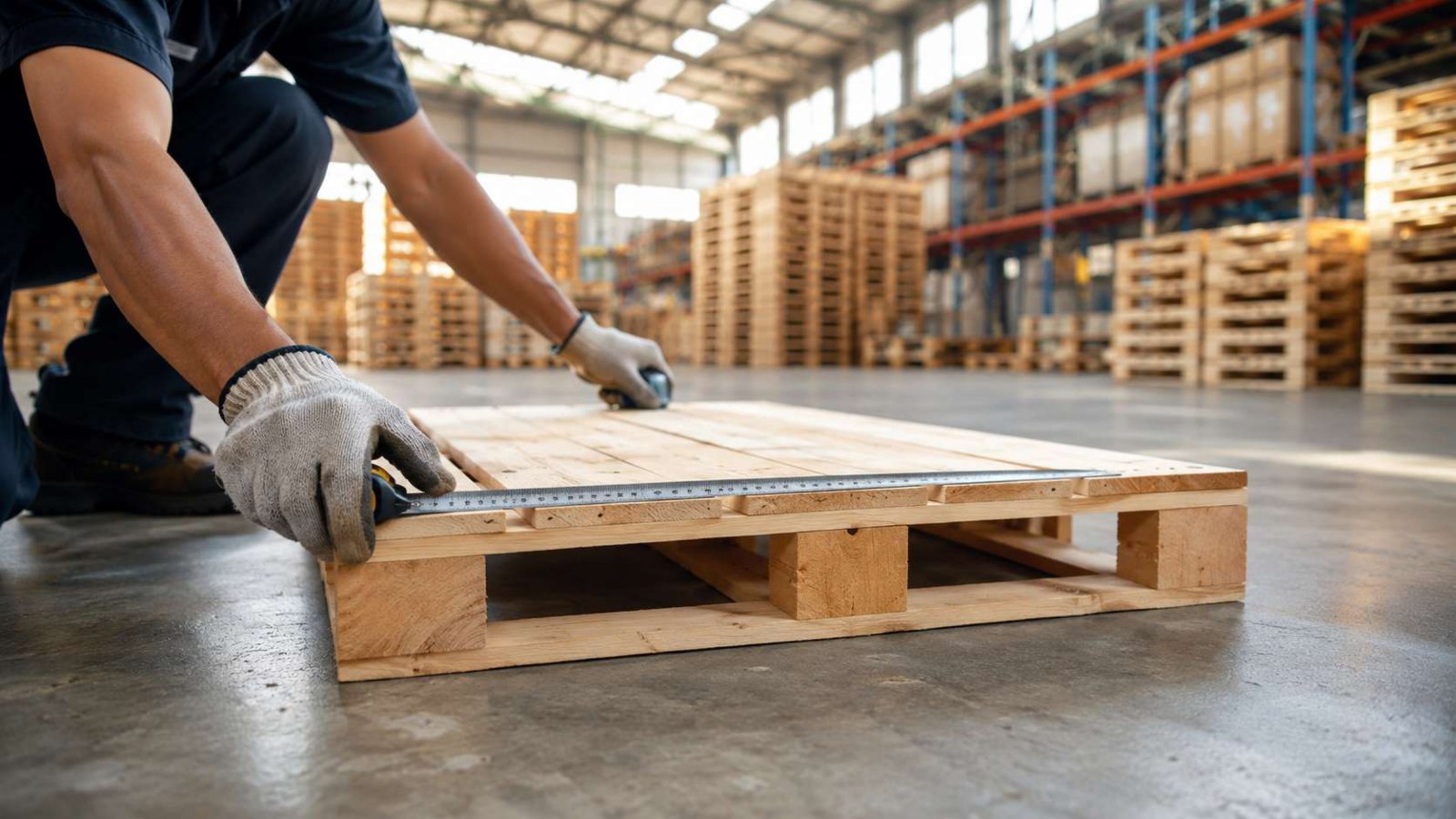
Container loading, racking compatibility, weight distribution, export market preferences — the right pallet size isn't just "whatever's standard". This guide walks through the factors that matter, the common sizes used in Malaysia and export markets, and when it makes sense to spec a custom size instead.
The pallet size you choose affects three things directly: how much you can fit in a container or truck, whether the pallet fits your racking and forklift workflow, and how stable the load is when it's stacked or in transit. Get it wrong and you're either shipping air, jamming racks, or watching boxes topple on a corner.
The Three Sizes You'll See Most in Malaysia
Most pallets moving through Malaysian factories and warehouses fall into one of three sizes. None is "better" universally — each fits a particular logistics chain.
1100 × 1100 mm — the Asian standard
This is the workhorse size across Southeast Asia and Japan. It fits efficiently into 20-foot and 40-foot shipping containers, plays nicely with most Malaysian racking, and is the default ask from regional exporters who aren't shipping to Europe or North America.
1200 × 1000 mm — the international hybrid
Close to a North American GMA-style footprint. Common for exports to the US and parts of Asia-Pacific, and for any operation that's standardised on imported racking systems. Slightly more container-efficient than 1100×1100 in some loading patterns.
1200 × 800 mm — the Euro pallet
The EUR-pallet, used across Europe and increasingly for Middle Eastern shipments. If you're exporting to the EU, your customer or freight forwarder will almost always ask for this size. Trying to send anything else can mean repacking at destination.
Three Questions Before You Commit to a Size
1. Where is the load going?
If the answer is "stays in Malaysia or ships to ASEAN," 1100×1100 is the safe default. If it's "ships to Europe," go 1200×800. If it's "ships to North America or my customer is on GMA standards," 1200×1000. The destination almost always decides for you.
2. What does your racking expect?
Selective racking, drive-in racking, and push-back systems each have a depth designed around a specific pallet size. Stocking a non-matching pallet means lost cubic capacity at minimum, and at worst pallets that overhang the beams and can't be safely loaded. If you're not sure, measure the depth between rack uprights and compare to the longer dimension of the pallet.
3. How does the product sit on top?
A pallet that's slightly larger than your carton footprint creates overhang on the cartons (bad — corners get crushed). A pallet that's much smaller creates overhang on the pallet (also bad — bottom layer cartons hang in mid-air and crush under stacking). Aim for the pallet footprint to be within a few centimetres of your case footprint, in both directions.
When Custom Sizes Make Sense
Standard sizes work for 80% of shipments. The other 20% benefit from a custom dimension:
- Bulky, non-standard items (machinery, panels, oversized parts) where standard sizes either waste space or leave the load unsupported
- Closed-loop reusable pools where you control both ends and can optimise for your specific carton footprint
- Tight container packing — where a few millimetres of pallet adjustment lets you fit an extra row of pallets per container
For our wooden range, custom is built to order with no engineering surcharge. Send us the dimensions; we send back a price.
Quick rule: if the destination is set and the carton footprint is known, the pallet size almost picks itself. Where it doesn't — that's the conversation to have over WhatsApp before you order.
Common Mistakes
- Specifying by old habit. If your operation switched export markets in the last few years and your pallet size didn't move with it, you may be paying for repacking at destination without realising it.
- Mixing sizes within one load. Mixed-size pallets in one container don't stack stably and waste vertical space.
- Ignoring the racking team. The person managing your warehouse usually has the strongest opinion about pallet size and is usually right.